Why Write?

I have been tasked with writing an article to encourage people to join our Kings Ridge (Clermont, Florida) writing group. The article will be published in the July issue of the Royal Times, our community’s monthly magazine. Now, usually I am working on a novel, but the editor of the aforementioned Royal Times will probably not appreciate receiving an 80,000-word manuscript, so I’m going to share an experience I had at the May meeting of the Kings Ridge Writers Group.

I will admit, I was not prepared for the meeting that day. I thought I would find (at the last minute, I might add) a page or two from the novel I was writing, print out ten copies, and call it a day. After all, I had less than six hours to come up with something. I always appreciate the feedback I receive at Writers Group and, since I’ve been stuck for a few months, I assumed the group would motivate me to finish the book sooner rather than later.

But fate stepped in. As has happened to me in the past, and again on that day in May, I received a telephone call that prompted me, instead, to write a personal essay. This is not that essay–this is an essay about writing the essay. (Not too complicated, right?)

The first time this happened, I heard some disturbing news that had been lessened in its severity by sitting at my computer and writing about what happened. I then learned I felt even better after sharing the story with my fellow writers and receiving helpful feedback–not on my writing, but on how to process the information.

So, on this day in late May, it happened again–more bad news. When I learned another friend had been diagnosed with an illness related to Agent Orange after having served in Vietnam, I found myself drawn to writing.

As an author of historical fiction my first instinct was to turn to research. My first three books take place in the seventies and the first book recounts one of my character’s experiences in Vietnam.

Hmm, Agent Orange. I’ve heard about it for decades, but now I am writing about it, so, let’s go searching.

The first search was ‘How many Vietnam veterans have died from Agent Orange?’ I thought it was a straightforward question, no ambiguity, but then this appeared on my screen–300,000. I was taken aback.
As I continued the research, I determined that if the 58,000 names inscribed on The Wall of the Vietnam War Memorial take up two acres of land close to the Washington Monument, then we will need another eight acres just to catch up to the number on my computer screen.

My source for the Vietnam chapters in the first novel, Always Forever Us, once said, “Many more soldiers died in Vietnam but didn’t know it at the time.” Now, decades later, they were finding that to be true.

When I shared my personal essay at the May meeting of the Writers Group, my voice broke several times as I recounted the 300,000 number and that our military had used twenty times the recommended amount of dioxin, the deadly chemical in Agent Orange, to defoliate the jungles of Vietnam, and that 400,000 Vietnamese had died, and that the chemical still found in the soil is continuing to affect their descendants to this day.

It may have been a coincidence that I wrote that essay just five days before Memorial Day, but then again, spiritual things have happened before when I wrote about a personal experience.

My point in sharing this is that, again after a little research, I confirmed what I already knew: writing is a recognized form of stress relief. Journaling, writing a memoir or personal essay–whatever you want to call it–helped me process my feelings, but even more helpful was the response from my fellow writers. They are nonjudgmental and I knew whatever I wrote would stay within the group (until I blog about it). We are supportive. End of story.

So, why write? I’ll leave that up to you to decide.

Voice

What is voice? As a novelist, it is the combination of tone, word choice, and point of view, or persona, of the narrator. You can probably find a better definition, but let’s go with mine. Another kind of voice is related to music. Today, I am using my voice as a narrator to write about my singing voice.

That’s me in 1971

But first let’s go back to 1967, or maybe ’68, when I received a special invitation in the mail to join an exclusive club. I knew it was special because ‘A Special Invitation’ was printed in a large font on the envelope addressed to me, Debbie Turner, a junior in high school. This was a major coup. I had been ‘selected’ without instigation on my part, just selected out of the vast number of teenagers out there to join the Columbia House Record Club. A record club! Imagine that.

Now, you need to know that at the tender age of sixteen and weighing no more than 75 pounds, I was working at the local A&W Root Beer drive-in establishment as a carhop, yes. a carhop. I see you are imagining me in a poodle skirt and on roller skates, but no, this was 1967, not 1957. Plus, if I’d had to carry those trays with heavy glass mugs full of root beer on skates, well, let’s just say I wouldn’t have lasted through one shift.

As a result of my employment at such a discerning place, I earned enough money to put a doozy of a record player on layaway. It was portable, had a fold-down turntable and detachable speakers. As you can imagine, the wages at the A&W would have to be significant for me to afford a Magnavox record player. Didn’t I say it was a doozy?

Yes, I was rocking that midway. That’s what our boss called the sidewalk under the aluminum awning where I walked with the trays and placed them on partially lowered car windows. Although at forty cents an hour plus tips (I imagine the customers felt sorry for the skinny four-foot-nine teenager because the tips almost made up for the dismal hourly wage), it took me more than one summer to earn the moolah for the Magnavox.

Eventually, I rescued my record player from the layaway. It took longer than I had hoped because my mother would not advance me the cash. She thought I would learn more about money if I earned every penny before receiving the reward–as if schlepping root beers during the summer and winter hadn’t impressed upon me enough the value of a dollar–but in all sincerity, I thank her. My mom’s lesson is still helping me today.

It was after the record player took up residence in my bedroom that I received that all-important invitation to join the Columbia House Record Club. Now, the reference to voice can take shape.

I was probably one of the few people in my exclusive club to actually return the subscription card before an album I didn’t want was shipped. That was because I spent enjoyable hours, if not days, studying the catalog for records that caught my attention and let’s just say my taste was, uh, eclectic.

Andy Williams, the Ray Coniff Singers, and soundtracks from Broadway musicals were some of the choices I defended when my friends scoffed at my collection. I was what could be described as musically nerdy because by 1968 my classmates were listening to Steppenwolf, Jimi Hendrix, and Janis Joplin while Julie Andrews and I were singing about “A Spoonful of Sugar”.

One month, I saw an album put out by Sergio Mendes and Brasil 66. No, Spellcheck, that not a typographical error. It is the spelling used by my friend Sergio’s home country of Portugal. (I hope we Americans spell that correctly!) I loved Sergio’s rendition of the Beatles hit, Fool on the Hill, and later Simon and Garfunkel’s Scarborough Fair. Of course, his cover of Burt Bacharach’s The Look of Love has stood the test of time, but it was One Note Samba that was stuck in my head.

Then, in 1969, my trusty Magnavox record player and I went to college. I brazenly played the records in my dorm room. In-A-Gada-Da-Vida may have been blasting throughout the floor, but the Samba versions of Night and Day, Day Tripper, and Goin’ Out of My Head were floating in the stratosphere of Deb’s room. Although I was a fan of Simon and Garfunkel, the Beatles and even the Monkees, I developed a soft spot for Sergei’s sound.

I have been involved in music since I started taking piano lessons in the second grade. I sang in a children’s choir at church and later, in high school choirs. I was a voice major in college with the goal of being a music teacher. Before I went to work for the Missouri Department of Elementary and Secondary Education coordinating fine arts in schools, I taught music in a public school for twenty-five years.

I couldn’t imagine my students–first highschoolers, then children ages six to twelve–being interested in my musical preferences for Bossa Nova and Samba, so I put my first loves away and enjoyed more mainstream music choices. Those were wonderful, memorable years and I enjoyed them immensely.

Now, as a retiree, I perform in a singing duo as Deb and Dave. As singing partners go, I’ve got the best. While I was in Missouri singing in my high school choir, Dave was playing saxophone and singing in a soul band at teen and adult clubs in Virginia. The Uprisers Band and Show successfully opened for Patti LaBelle and the Manhattans and they sat in with well-known soul musicians like King Curtis. Wow!

So, Dave knew a lot about soul, rock and roll, Motown, and, of course, country music. (His dad played in a band called the Tumbleweeds.) That doesn’t go too well with Samba, Bossa Nova, and a little Joni Mitchell Both Sides Now, does it? But since I’d put all that behind me decades earlier, I learned to love what our duo did and some of what the band we established played.

I play keyboard in the band. Dave is the saxophonist our good friend and extremely talented guitarist, Jimmy rounds out the trio. We all sing. My difficulties arose when I needed to play music that was unfamiliar. I could play the traditional chord progressions of pop and rock music, but once, well more than once, I was asked to play “Honky Tonk” piano. Dave would mime pounding on the keys in a helter-skelter manner. I would try but it wasn’t natural to me. As a piano minor in college, my preferences were more along the lines of Bach and Mozart, not Little Richard. (I’d never used a foot on the keyboard in my life!)

When I tried to be more modern, I realized it was not natural for me and I had a feeling the audiences knew it, too. But what was natural was singing the songs from my Sergio Mendes albums.

That brings me to a few months ago. While Dave and I were dining out, I heard a recording of a Beatles song but with a Bossa Nova beat. I was intrigued. At home, I immediately researched Bossa Nova Beatles music online and it didn’t take long to discover several singers with similar styles to what I’d heard that night.

A short time later, at a Deb and Dave gig, I introduced one of my new Bossa Nova songs and found the audience appeared to like what they heard. Now, in addition to our Motown, pop, country, and rock and roll repertoire, Dave happily plays his saxophone on our new tracks, and I found my new voice.

But between you and me, that voice was really created more than fifty years ago.

What’s In A (Pen)Name?

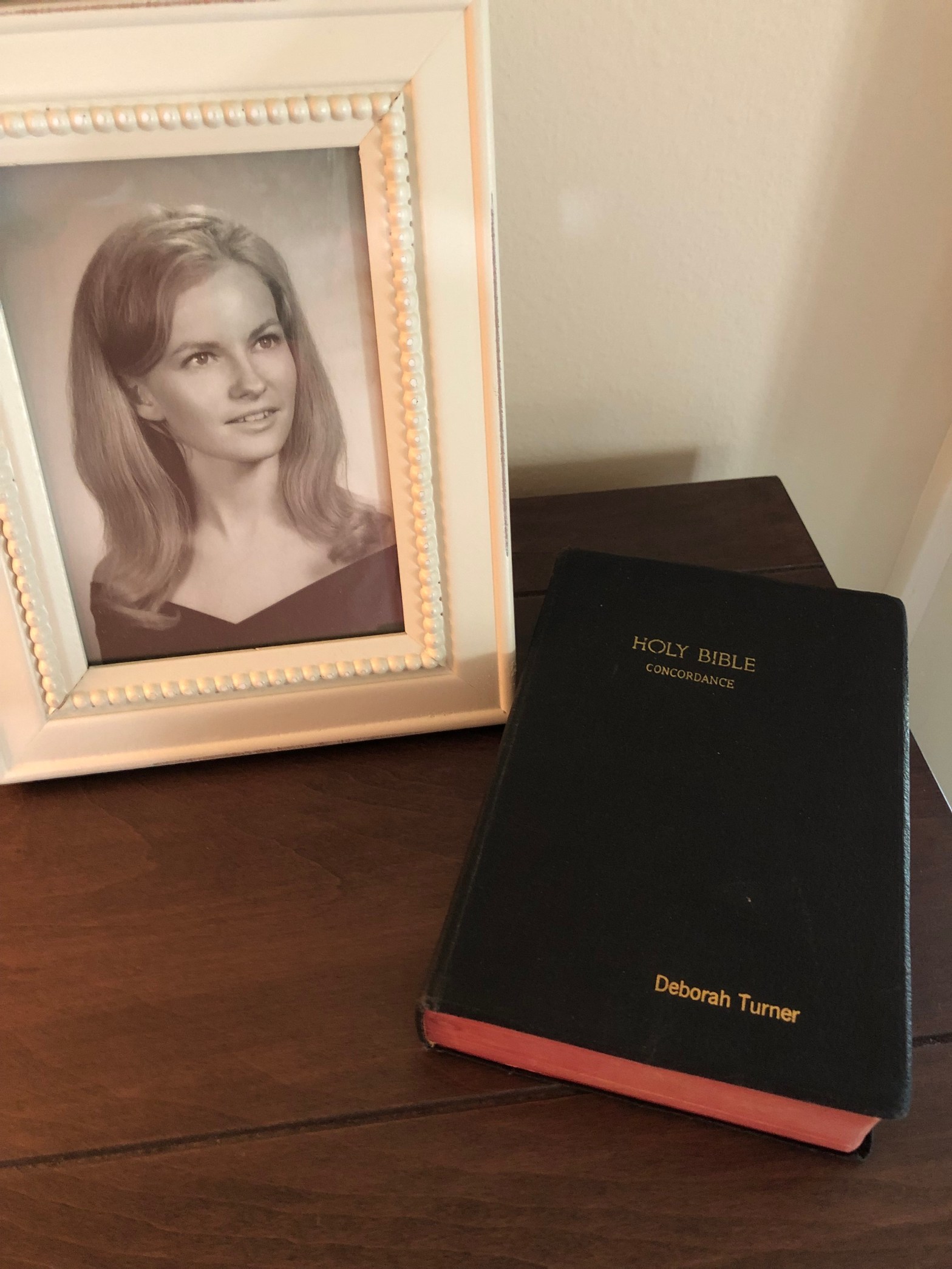
If you are reading this, you are visiting my website, DeborahTurnerAuthor.com. (I thank you very much for coming.) The photo included with this post is of my 1969 high school senior picture and the Bible presented to me by the Women’s Society of Christian Services (WSCS) of the Hillsboro United Methodist Church, Hillsboro, Missouri in May 1969.

Recently, I came across my Bible on a bookshelf beside Sophie Kinsella’s first Shopaholic book, Confessions of a Shopaholic, (which I consider her best, but I digress) and an Instant Pot cookbook. It had been years since I read Shopaholic and two years since I put my Instant Pot on the top shelf of my pantry that I couldn’t reach without a ladder, so don’t judge me that I didn’t have my Bible from 1969 close at hand. 

But I do now. Two years ago, I kept the name most people know me by, Deborah Fisher, during the dissolution of my marriage of over forty years, but when I saw that Bible I knew I wanted to see the Book and Deborah Turner, my name—my given name—every day. 

Something in me was awakened when I thought about being Deborah Turner again. I felt two things. One, I found again a part of who I had been from 1951 to 1972, and two, I could be that girl again. I celebrated my seventieth birthday less than two months ago, so it seems a bit foolish to type the word ‘girl’, but that’s what I was the last time I signed my name with Turner at the end. Perhaps, I can pick up where I left off. 

Two months ago, during an interview by the editor of my 55+ ‘active adult’ community magazine about reinventing my life during retirement, I picked up the Bible that was now sitting on a table in my great room. As I showed it to her, I said, “I feel young when I see my name printed here, so I chose to use the name of the younger me on my books.” 

Now, when I see Deborah Turner on the cover of two books and I look at my senior picture, I believe that slight smile of the eighteen-year-old me is a nod of encouragement for making her proud.  

Feminism in the Teacher’s Lounge

Always Forever Us is not my story, it is fiction, except for the Jake character, he is real. My main character, Julia, may be born of my imagination, but we share some experiences and opinions. We both had gender-biased male bosses and we both found our own way to stand up for ourselves.

But my story wouldn’t make for compelling reading. You see, I was a teacher in a small town. Well, it couldn’t really be called a town although there was a gas station and a small grocery store, a thriving garden shop and a quaint village close by. Anyway, my school was in a rural area but close to a large city.

I began my teaching career in 1973. I was interviewed for a grades 6-12 vocal music position by the middle-school principal. I saw the job on my college’s office for connecting graduates with people hiring graduates. I had been searching the notebooks with listings for teaching jobs for a year, then when I saw a music teaching job, I would type a letter to the school district on my portable Sears typewriter. Often, with only one music teacher in a building, or even in a district, there were fewer job openings than those for a classroom teacher.

When I saw Mr. H’s name on the listing for a job in the county where I had grown up, I jumped on the opportunity. I called my parents and said, “Mr. H. is hiring a music teacher. Can you put in a good word for me at church?” My mother reminded me that when my father was on the local school board at the elementary school I attended, he had hired Mr. H’s wife. She was my second-grade teacher and later, my art teacher.

I had an “in”!

Sure enough, Mr. H. was interested in hiring me, but had some reservations about my size. This was middle school and senior high school after all, and, like Julia, I was two inches shorter than five feet tall. Mr. H. was concerned I would not have the demeanor or size to discipline students who were sometimes a foot taller than me.

Aha! I had that covered. During the year I spent looking for a teaching job I was a substitute teacher at three or four schools. Most of them were high schools. I suppose I was known at these high schools for being tough, and I hope fair, but at any rate, I was able to control a classroom. In fact, I can still remember the times when I would be walking from the parking lot to the school and students would ask who I was that day. Upon hearing my reply, they were either happy they wouldn’t have me, or they would groan.

So, when Mr. H. mentioned his concerns, I asked him to call the principals of the schools where I had substitute taught. Within hours, I had the job.

I can’t remember where I got the MS mug, but I took it with me on my first day of teaching. I left it in my cubby in the teacher’s lounge where all the other teachers left their mugs. The cubbies allowed the school secretaries to put notices in one place rather than walk around the building handing out slips of paper telling us to do this and not to do that.

After a few weeks, I was visited in my classroom by Mr. H. He had my MS mug in his hand. I was rehearsing a choir and just nodded as he placed the mug on my desk. Later that afternoon, Mr. H. found me in the teacher’s lounge where I had, once again, taken my mug for my afternoon cup of tea. He told me not to leave my mug in the lounge. I said, “Okay,” and went on my way.

I put the mug on my desk and used it as a pencil cup. Several days later, Mr. H. told me he meant that I should take it home and not bring it back because he found the women’s libbers to be offensive. I don’t think he used those words, but that’s what he meant.

Now, remember this is 1973. Women could be fired for getting pregnant, the Title IX prohibition of discrimination in athletics—well, it stated any educational program receiving federal funds, but we all knew it meant athletics—had been passed in 1972, and if I were to apply for a credit card the company could ask for my husband’s permission before putting the card in my hand.

Many of us have referred to this time in the early seventies as women burning bras and students burning flags. Women protested gender inequality, but we didn’t have that fancy phrase, we just called it women’s rights, and students protested the war in Vietnam. Both groups were having some success in changing people’s opinions.

Except the opinion of my principal. There were no women administrators in my school district and if I recall correctly, no women on the board of education. While women were the majority in the classrooms, men ruled the district. I was a first-year teacher without tenure and my MS mug was a hill I wasn’t willing to die on. I took my mug home, placed it in my cabinet and recalled the encounter with Mr. H. every time I pulled it out. Thirty-seven years later, I still have the mug and I still recall the day Mr. H. found my innocent little mug offensive.

But I’d say that I have the last laugh. The bra burners and flag burners were successful. The war ended that year and in 1974 it was illegal to refuse credit based on gender. Five years later it was illegal to fire a woman because she was pregnant.

Although the sixties was the decade of free love, the early seventies was the beginning of peaceful, and sometimes not-so-peaceful, protest. You’ve come a long way, baby.